
Meet The Member: Patrick Rakau – Better Food For Healthier Farms
“Research always matters – but demand-led research is the way to go. In other words, make sure your research is something that people really need – and that can change lives for the better” For forage and range scientist Patrick Rakau, his work as a researcher at the ARC Animal Production Institute isn’t about finding new ways to feed farm animals – it’s about making a difference.
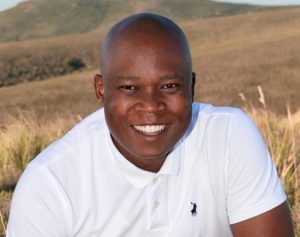
Patrick Rakau’s role as Researcher at the ARC Animal Production Institute is about improving livestock nutrition all over South Africa – and beyond.
The Agricultural Research Council’s Animal Production Institute carries out primary and secondary research, development and technology transfer with respect to Animal Breeding and Improvement, Rangelands and Nutrition, and Food Science and Technology to improve productivity and sustainable resource utilisation. In addition, this research focus area serves as the custodian of national assets such as the conservation of animal, forage and bacterial culture collection genetic resources, including databases and DNA banks associated with them.
“We are the only government entity that’s involved in the breeding and production of forage cultivars in the country,” Patrick notes. “Without us, it would be only the private sector breeding and producing forage seeds and cultivars for our farmers. That’s not to say they don’t do good work – but without the competition, this would lead to higher prices and less food security.”
Growing up in rural Limpopo at Ga-kgapene village Mediengen, Patrick was no stranger to the needs of animals, having helped his grandmother care for pigs, chickens and goats from an early age. But when he saw goats having to eat plastic because there wasn’t enough vegetation, he decided to do his best to improve livestock nutrition.
Patrick completed a junior degree in Agricultural Management, an Honours degree in Pasture Science and an MSc in Pasture Science at the University of Limpopo. He switched to plant breeding after completing his MSc, spent eight years as a lecturer at Glen College of Agriculture, and finally joined the Agricultural Research Council (ARC) as a Researcher.
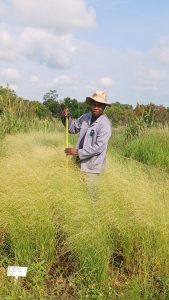
Patrick Rakau is an accomplished agricultural researcher, a specialist in forage and range science, and an expert in what it takes to keep farm animals well-fed.
Patrick’s research advances sustainable livestock production through the development of climate-resilient and nutrient-rich forage crops. His work supports food security and environmental sustainability by improving the productivity and adaptability of pasture systems under changing climatic conditions.
“As a pasture scientist, my principal role is providing high quality and enough quantity forage to livestock,” Patrick says. In the ARC’s forage genebank, I evaluate forage species for agronomic characteristics before getting them into the genebank for short- or long-term storage. I also lead a breeding programme including a radish project for late flowering traits and hard tuber or not rooting tuber. Lucerne project for tolerance to acidic soils, stooling rye projects for high biomass production and persistence and tef dual purpose project. I also lead the cover crop and fodder bank production national project”.
At the same time, as project leader of the National Cover Crop Programme funded by the Department of Agriculture and Rural Development, he has coordinated multi-provincial collaborations to promote sustainable agricultural practices, authored popular articles about his work, and conducted award-winning research.
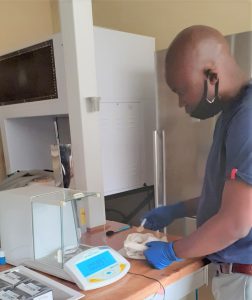
Patrick Rakau’s research advances sustainable livestock production through the development of climate-resilient and nutrient-rich forage crops.
And he’s not done studying yet either – Patrick is currently completing a PhD in plant breeding at the African Centre for Crop Improvement (ACCI) based at the University of KwaZulu-Natal, looking at.the “Response of Ethyl Methane Sulphonate-Mutagenized Tef [Eragrostis tef (Zucc.) Trotter] for Dual-Purpose Traits”.
“I chose my research topic based on the need to develop improved forage cultivars to replace older cultivars with expired plant breeding rights (PBR),” he says. ““These improved varieties are showing promising traits, such as reduced lodging and potential drought tolerance, making them valuable for future breeding and cultivation. Their development could contribute to enhancing the production and resilience in various growing conditions.”
It’s a lot of work for anyone – but Patrick finds a way.
“Well, I’m married, and I have nine children, so free time can be hard to come by,” he laughs. “But I enjoy going to church on the weekends – I’m actually Secretary of the Church Committee. And of course, I love spending time with my family as well!”
Patrick believes strongly in community, and in helping people prosper. So he doesn’t keep his scientific findings to himself.
“When I have the time, I try to share my skills and knowledge with my community, especially with local farmers and traditional leaders,” he says. “I am very close to the chief Kgapane Malekoto from Mediegen village, so we can exchange knowledge easily.”.
So what’s next for him?
“Next step is to complete my PhD, and then keep researching and doing forage evaluation and breeding using different methods, e.g mutation breeding. And then eventually I’ll start my own fodder and forage seed production and breeding business – the first black-owned seed company in South Africa. This will allow our small holder farmers and communal farmers to access certified seeds with affordable prices and quantities.
“And after that, who knows?”
Want to know more about the ARC Animal Production Institute, or the many other ARC biobanks? Just watch this. Or read more here. And while you’re at it, why not learn more about what biobanks are (and aren’t) all about?


What are biodiversity biobanks?
Biodiversity biobanks are repositories of biologically relevant resources, including reproductive tissues such as seeds, eggs and sperm, other tissues including blood, DNA extracts, microbial cultures (active and dormant), and environmental samples containing biological communities….
