
Stephanie Lawrence – Mad About Microbes
Fun fact: There are more microbes in a few grams of soil than there are people on the entire planet. Bacteria, archaea and other microorganisms – and viruses – come in a bewildering diversity of shapes, strains and species, live in a wide range of environments, and may hold secrets that could vastly improve our lives, if we only knew more about them. Luckily biobank technical officer Stephanie Lawrence is here to help.
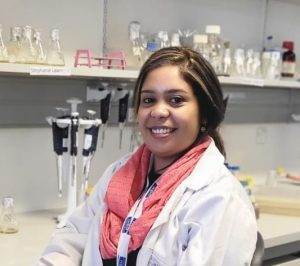
Stephanie Lawrence in the lab, doing what she does best.
Stephanie is the Biobank Technical Officer at the Institute for Microbial Biotechnology (IMBM) at the University of the Western Cape (UWC). The institute is considered a global competitor in microbial biotechnology and metagenomics, with a collection containing about 4 000 bacterial strains – mainly marine bacteria, but also a range of bacteria from several other unique indigenous environments…like the insides of sponges (the animals, not the ones in your bathroom).
“Microorganisms may be so small as to be invisible, but they’re really big when it comes to diversity and importance,” she says. “They’re everywhere, they’re ecologically important, and they produce products that can be used in everything from anti-inflammatories to yoghurt, and more. They’re a goldmine for research, and a big part of our daily lives. And they’re cute as well!”
Stephanie didn’t always dream of working with microorganisms. But when she volunteered at the Two Oceans Aquarium in high school, the life she saw under the microscopes (“You could see the polyps of the jellyfish and like the tiny baby barnacles!”) had her hooked. So she enrolled for a BSc in biotechnology at UWC…and didn’t stop. She went on to obtain her Honours (cum laude) and her Master’s at the University – and didn’t stop there.
“Science has always been my thing,”she says. “I wanted to be a marine biologist – and I ended up working with microorganisms from the ocean. So I’m not too far off, really.”
Her Master’s thesis was – naturally – on microorganisms, and specifically on Food spoilage associated with Chryseobacterium. (“That was intense. It meant culturing bacteria from chicken wings, checking the difference in microfauna over a time period, and that chicken wasn’t exactly a pleasant smell…but microbiology is fun! Really!”)
While she was doing her Master’s, she learned about a job opportunity coming up at the IMBM – a chance to work with something called the Biodiversity Biobanks of South Africa, helping to organize the BBSA’s core microbial biobank.
“It seemed like the perfect opportunity,” she says. “As someone that is interested in bacteria and other microorganisms, I’d be getting exposure to a variety of them. Not just one species or one genus, but thousands. And I’d be able to play a role in getting these microbes the recognition – and the research – they deserve.”
She got the job, naturally. And she’s certainly made the most of it – improving her skills, attending international conferences, and finding new ways to give the collection the attention it deserves.
So what’s it been like? Here’s what Stephanie has to say about life (big and small) at the IMBM…
What makes the IMBM biobank so interesting?
It might sound grandiose, but the biobank matters because it gives everyone access (following the proper processes) and makes different microorganisms available to researchers. And these are microorganisms that have been isolated from diverse and extreme environments – hot springs, coastlines, and so on – and there are diverse and interesting microorganisms in those collections that haven’t been fully explored. And the type of products or metabolites that they produce – who knows what they could be used for?
So what’s a typical work day like for you?
My typical work day consists of growing bacteria: culturing them and then storing them n a manner that means they can always be viable (even after being stored at -80oC); making glycerol stocks of them; identifying or determining the viability of the isolates that I’m working with; checking the quality, whether there’s contamination or not. And we’re also looking into sequencing the isolates that I’m working with, because there’s often no sequencing data. So that’s my day-to-day in a nutshell. It’s a lot, and it always takes longer than expected…but the nice thing is that, when I’m done, I know I’ve put in a hard day’s work. It’s really very rewarding.
What do you do to relax?
I’ve tried crocheting – it makes me feel closer to my late grandmother. And I have a guitar, and a ukulele. So sometimes when I’m going through a lot, I like to play those – especially the ukulele. It’s perfect for small hands.
You play the ukulele?
Well, I’ve had a guitar since I was eleven. I went to the beach with my family and there was this guy playing his guitar, and there were all these people sitting around him. And I wanted to be that person, you know? And then when I went to university, some of my friends knew I wanted a ukulele, so they surprised me with one for my birthday. So now, whatever song I feel like, I just look up the chords, and I play. I’m not a pro, but I used to play in the church when I stayed in Malmesbury. Maybe I’ll take the show to the beach someday, and achieve another dream :)
What are your dreams for the IMBM biobank?
I think what matters most is for the biobank to be used – and shared. At the end of the day, we’re not just culturing or storing these microorganisms for ourselves, or checking viability of cells. The point of the biobank is so that these organisms or microorganisms get shared with other researchers, all around the world. Luckily, we’ve had some interest in that locally and internationally – and we’d love to see every strain studied as thoroughly as they deserve.
And for yourself?
For now I’m just taking opportunities as they come, and just going for it. This job has proved to me that I shouldn’t doubt myself, or my experience, or the hard work (from myself and others) that has brought me to this point. My friends and I sometimes talk about the dreams we had in undergrad, and how they’ve come true. We are walking in our dreams – so let’s see how much further we can go.
Any advice for someone considering a career in science?
Don’t give up, and don’t lose focus of why you’re doing what you do. It gets difficult and hectic and stressful, yes – but follow your passion, and it will take you to where you need to be. I mean, I’m here. And also – this is something my supervisor liked to say – every little bit that you do amounts to something. So even if you’re overwhelmed, just do a little bit now, instead of doing nothing. It adds up.
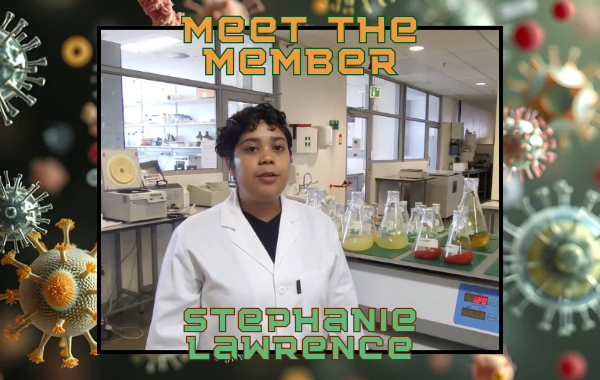
Still curious about what a day in the life of a biobank technical officer is like? Watch Stephanie explain it here. Want to know more about the Institute for Microbial Biotechnology and Metagenomics? Just watch this. And while you’re at it, why not learn more about what biobanks are (and aren’t) all about?


What are biodiversity biobanks?
Biodiversity biobanks are repositories of biologically relevant resources, including reproductive tissues such as seeds, eggs and sperm, other tissues including blood, DNA extracts, microbial cultures (active and dormant), and environmental samples containing biological communities….
