
Biobanking News | Getting The Good Genes: Plant DNA Biobankers At The High Molecular Weight DNA Jamboree
Working with DNA can be a tricky task. And that’s especially true when working with long, unbroken DNA fragments. These high molecular weight DNA segments can be used to support a variety of important genomic analyses – but only if researchers know how to handle them. That’s why Mpho Mohlakoana and Sydney Ramulifho, research technicians at SANBI’s Plant DNA Biobank, attended the HMW DNA Extraction Jamboree.
Standard genomic DNA extraction often shears DNA into small pieces. HMW DNA extraction keeps long stretches of the chromosome intact,resulting in very long, unbroken chains of DNA that usually measure more than 50 kilobases (kb), and can reach into the megabase (Mb) range.
These high-integrity strands are useful for several reasons. For example:
- Long-Read Sequencing: Platforms like Oxford Nanopore Technologies and PacBio require HMW DNA to read thousands of base pairs at once.
- Genome Assembly: Long strands help scientists piece together repetitive areas and complex regions of a genome that short reads miss.
- Structural Variation: It aids in finding large insertions, deletions, or rearrangements in research areas like cancer and human genetics.
Unfortunately, these strands are also comparatively fragile, so normal lab actions like vortexing, rapid pipetting, or freezing can break them apart. And high concentrations of HMW DNA form thick, gel-like solutions that are hard to mix and measure. So specialised kits and methods are needed to handle them.
And that’s particularly important for biobanks like the SANBI Indigenous Plant DNA Biobank.
South Africa is a known biodiversity hotspot, boasting over 22 000 indigenous plants of all shapes and sizes, many endemic to the country. That’s a lot of plants that need preservation, and plant genomes can be particularly large and complex – which is why the South African National Biodiversity Institute established a DNA biobank to conserve and support research for this precious resource.
And that’s why the young biobankers joined postgraduate students and researchers from eight institutions, working with 150 samples representing 37 unique species, including plant, fungal, invertebrate, bacterial and vertebrate cell samples.
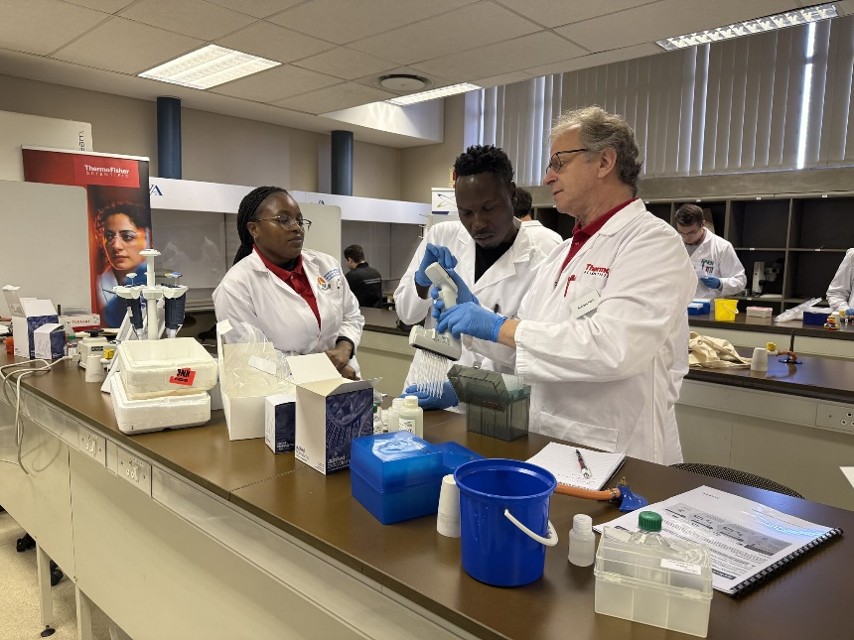
Plant DNA Biobank Technician learned to use an HMW DNA extraction kit directly from the Thermo Fisher Scientific team at the HMW High Molecular Weight DNA Jamboree.
Hosted by the University of Pretoria Genomics Laboratory in July in collaboration with DIPLOMICS (Distributed Platform in Omics) and the African Centre for Gene Technologies, the HMW DNA Extraction Jamboree was a four-day hands-on workshop focused on different methods of extracting high-quality, high-molecular-weight DNA.
The workshop created a practical platform for postgraduate students and researchers to test different HMW DNA extraction methods using their own samples. With kits sponsored by Thermo Fisher Scientific, Anatech Instruments, SEPARATIONS, Zymo Research Corp , inqaba biotec, and QIAGEN, researchers were able to compare approaches and work alongside technical specialists to optimise extraction outcomes for diverse sample types intended for long-read sequencing.
“The most interesting part for me was gaining practical experience with different HMW DNA extraction methods and seeing how each method performs with different biological samples,” notes Sydney. “I also learned more about the importance of assessing DNA quality after extraction.”
The extraction sessions were followed by DNA quality assessment using NanoDrop, Qubit and TapeStation, as well as a collective discussion of the results and lessons from the different methods tested.
“The hands-on experience was particularly useful. It helped me understand how DNA concentration, purity and integrity can influence downstream applications such as sequencing.”
The workshop has already proven itself useful.
“I’m applying the techniques to plant samples and making better decisions when selecting an extraction method based on the type and quality of the sample. This experience will also strengthen my ability to prepare high-quality DNA for downstream applications, including long-read sequencing.”
Not only does the SANBI Indigenous Plant DNA Biobank process samples of its own, but it also provides guidance and training in handling DNA samples for many of the other biobanks in the Biodiversity Biobanks South Africa (BBSA) network.
“The Jamboree was very relevant to our work at the Plant Biobank, especially DNA extraction and sample processing,” says Sydney. “The knowledge and practical skills we gained will help improve the quality and consistency of DNA extraction at the biobank – and perhaps even at other biodiversity biobanks in South Africa.”
Want to learn more about SANBI Indigenous Plant DNA Biobank? We’ve got you covered. Or find out about the other BBSA partner institutions here. And while you’re at it, why not learn more about why biobanks matter to South Africa – and the world?



What are biodiversity biobanks?
Biodiversity biobanks are repositories of biologically relevant resources, including reproductive tissues such as seeds, eggs and sperm, other tissues including blood, DNA extracts, microbial cultures (active and dormant), and environmental samples containing biological communities….
