Meet The Member: Gretha Snyman – The GOAT of Goat Biobanking
Gretha Snyman always knew she wanted to work with animals. Her guidance counselor told her she could breed them (as a farmer), kill them (as a researcher), treat them (as a vet) or train them (in the circus). So she decided to do all four in one job, managing the Grootfontein Biobank for Sheep & Goats at the Grootfontein Agricultural Development Institute (GADI) in the Eastern Cape.
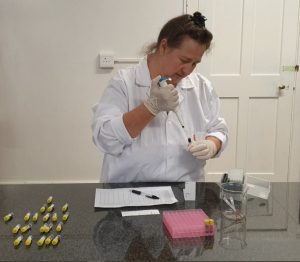
Dr Gretha Snyman doing what she loves – helping find out more about farm animals.
“I grew up in North West Province on a farm near Potchefstroom,” she remembers. “I studied Studied Agricultural Sciences – Animal Production at the University of Pretoria, did my postgrad studies in animal breeding and genetics, also at Univ of Pretoria (MSc) and Free State (PhD). I started working at Grootfontein Agricultural Development Institute near Middelburg in the Eastern Cape in 1987 and I am still here! So now I am breeding animals and doing research on them. We are even training them in some projects – and my husband is treating the sick ones!”
One of two Biodiversity Biobanks South Africa (BBSA) biobanks belonging to the Department of Agriculture, Land Reform and Rural Development (DALRRD), the aim of the Grootfontein Biobank for Sheep & Goats is to collect and store biological samples, phenotypic and genomic data from resource and reference sheep and goat flocks (as the name implies).
With 11 research and private flocks of six different sheep and goat breeds, and around 250 000 samples from over 60 000 animals, the biobank has a wealth of resources available to research institutions for genomic research purposes.
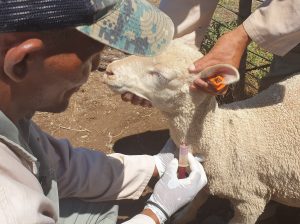
Just another day at Grootfontein Biobank for Sheep & Goats.
“My biobank duties include keeping the phenotypic data collected every year up to date, keeping the blood samples collected up to data in the files, then selecting animals and associated data for requested projects. This usually entails a lot of data analyses as well, as the animals are usually selected on breeding values that have to be calculated at first.”
Here’s what Gretha has to say about work, play and life on the (proverbial and actual) farm…
What’s a typical work day like at Grootfontein?
Well, I’m a researcher – I don’t really have a typical day. I have a lot of projects – 14 at the moment (!) – and they all have their own complexities, so I do not do the same thing day-after-day. In general terms, it might be the same, but in practice it is not.
So in general terms, then…what’s work like at GADI?
There’s a lot of data collection, and data capturing, and data analysis. As I’m old now, I can send the young guys to do the actual data collection on the animals most of the time – though I do still do it myself sometimes, along with much of the data capturing. And then there’s the fun and interesting part – data analysis. That’s where we get to actually learn something new – the best part of being a researcher.
The other part is actually communicating that. So I must write up the results as either a progress or final report or a publication, which takes up a lot of my time – especially the literature searches and reviews. And then there are meetings, providing advice to farmers, reviewing articles for scientific journals, being an examiner for postgrad theses…
And of course, as GADI Biobank Manager, I have a lot of other duties as well.
Okay, but…How do you find the time?
Everybody says a researcher cannot be the manager of a biobank – and they’re right! At least, I agree to some extent that a researcher should not be the technical manager of a biobank (for the policies and all that stuff), because I do not have time for all that, but in our bank’s case a researcher should be involved in the process, where resources are requested from scientists from outside. To supply the most suitable samples and data, the person must have a knowledge of quantitative genetics and model specification for production and reproduction traits of sheep and goats, as well as know the data of the flocks in the banks.
What’s next for the biobank?
The existing biobanks have proven to be very useful in a number of studies so far. So we should keep maintaining them, of course. But we should also try to expand them, including more useful animals and more animals that are less closely related to the current animals in the reference population. And if we can add more performance data to what we collect, we’ll be in a position to do some very interesting work in future.
Anything the BBSA can help you with?
The main thing, I think, is assisting us with adhering to proper procedures and policies, data management and the quality control aspects of the biobank. And of course, funding for infrastructure would be good.
What do you do to relax?
Crocheting, watching DVDs and series, trying to complete the photo books on my children’s school years. And reading – fiction, not books that you have to think about the deeper meaning of whatever or whoever and that you have to discuss in depth with someone or a book club. I read enough articles at work that I must think about, thank you very much.
What’s one lesson you’ve learned from working at GADI?
If you want something done properly, do it yourself! Or have some really good people on your team – people who can do it themselves as well.
Want to know more about the Grootfontein Biobanks for Sheep & Goats? Just watch this explanation by Dr Gretha Snyman. Or find out about the other BBSA partner institutions here. And while you’re at it, why not learn more about how biobanks benefit South Africa?

Related Posts


What are biodiversity biobanks?
Biodiversity biobanks are repositories of biologically relevant resources, including reproductive tissues such as seeds, eggs and sperm, other tissues including blood, DNA extracts, microbial cultures (active and dormant), and environmental samples containing biological communities….
