
A Partnership for the Genomics Era: Expanding Biobank Potential Through DIPLOMICS Collaboration
As genomic technologies evolve, the scientific community increasingly requires DNA of far higher quality, sometimes beyond what traditional preservation methods were originally designed to provide. Techniques once sufficient for applications like DNA barcoding do not always yield the high-molecular-weight (HMW) DNA needed for next generation sequencing (NGS) applications. Without appropriate storage methods, the genomic value contained in a tissue sample could deteriorate before it reaches the laboratory for these specialised analyses.
To bridge this gap, the NRF–SAIAB National Aquatic Biodiversity Biobank, in partnership with DIPLOMICS, has launched a method development project aimed at identifying optimal long- and short-term preservation strategies for aquatic tissues.
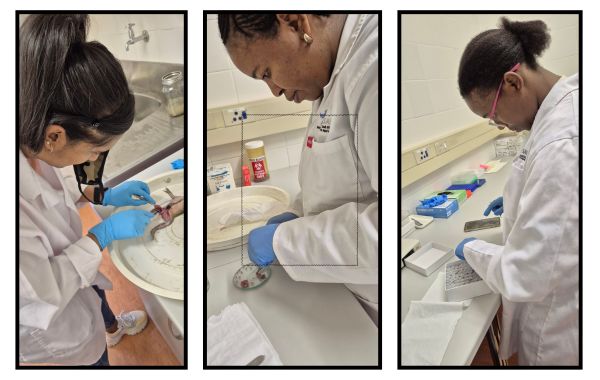
The NRF-SAIAB Biobank team – Seshnee Reddy, Amanda Gura and Sinoxolo Fiki subsampling the raucous toad, Sclerophrys capensis, as part of the project
About the Project
The project evaluates three commonly used preservatives – DESS (salt-based preservative), 99.9% ethanol (the Biobank’s current standard), and 95% ethanol, under a range of field and laboratory storage conditions using fish and frog tissue. DNA quality will be monitored over both short‑term (three months) and long‑term (two years) periods. By systematically comparing preservation solutions and conditions, the Biobank aims to identify storage practices that reliably yield HMW DNA.
Broad Impact
This project represents a strategic expansion of the Biobank’s role, enabling it to move beyond the provision of tissue samples to also generate and curate genomic sequence data, which are all linked back to individual specimens. Additionally, by improving the quality and long‑term integrity of tissues for omics workflows, the Biobank contributes to the BBSA’s goal of strengthening nationally coordinated biodiversity biobanking systems, while DIPLOMICS involvement ensures alignment with South Africa’s broader commitment to building world‑class molecular infrastructure and data resources. Through this collaboration, the Biobank not only optimises its own preservation standards but also aims to expand its research to a wider range of disciplines, including conservation genomics, ecotoxicology, disease surveillance, and climate change research.

Related Posts



What are biodiversity biobanks?
Biodiversity biobanks are repositories of biologically relevant resources, including reproductive tissues such as seeds, eggs and sperm, other tissues including blood, DNA extracts, microbial cultures (active and dormant), and environmental samples containing biological communities….
